Estimate Used iPhone Trade-In Value by Battery Health
Trade-in platforms rarely publish their depreciation math, but they share one number that almost every dynamic rests on: 80% maximum capacity.
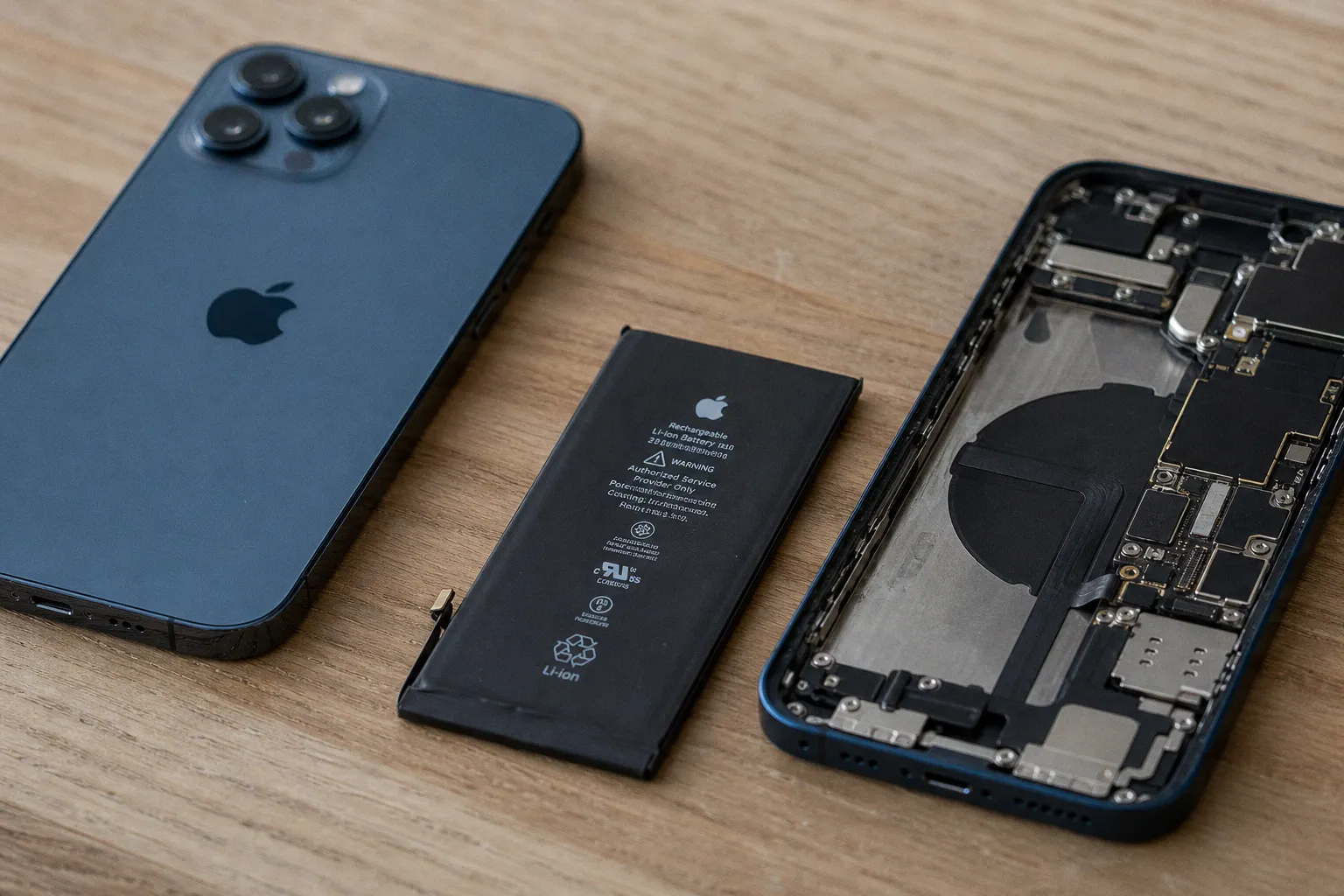
That figure is Apple's own threshold for classifying a battery as "normal," and it has effectively become the industry's appraisal pivot. Cross it from above, and your iPhone continues to read as a working device in the eyes of every major trade-in buyer. Cross it from below, and the offer collapses toward a recycling credit or disappears altogether.
We can map how that line is enforced at the major outlets, document the inputs each platform actually checks, and work out whether any move you can still make on a degraded battery is worth the cost before the device ships.
The 80% Threshold: Why Apple's Benchmark Matters for Resale
Apple introduced the Maximum Capacity reading inside Settings → Battery → Battery Health in iOS 11.3, released in 2018. The reading estimates how much of the original full charge the battery still retains relative to factory condition. Apple pairs the percentage with a charge-cycle target: a battery is designed to retain up to 80% capacity after 500 complete charge cycles. Both metrics describe the same wear curve in different units.
The 80% line is not advisory. Apple's documentation treats a Maximum Capacity at or above 80% as the operational baseline; below it, performance management features engage and the phone may throttle under peak load to prevent unexpected shutdowns. Trade-in buyers treat the same threshold as a condition signal — a throttled device behaves differently in real use and carries higher refurbishment cost on the buyer's side.
| Maximum Capacity | Apple's classification | Typical trade-in position |
|---|---|---|
| 100% – 90% | Normal | Headline-tier offers; minimal condition deduction |
| 89% – 80% | Normal | Standard offers; small deductions on strict platforms |
| 79% – 70% | Service recommended | "Poor" tier on Apple, Gazelle, Decluttr; quote revised down sharply |
| 69% and below | Service / degraded | Recycling-only offer or outright refusal on Apple's program |
The bands above are derived from the documented policies of Apple, Gazelle, Decluttr, Back Market, and Best Buy trade-in flows as of early 2026. Exact dollar deductions between bands are proprietary and unpublished — treat them as ordinal, not as quoted values.
The 80% maximum capacity line is the fulcrum: above it, your iPhone stays inside the normal trade-in tier; below it, the appraisal shifts into a separate, lower bracket that almost no instant quote will surface openly.
How Retailers and Third-Party Platforms Assess Battery Degradation
Each major trade-in flow handles battery health differently, and the inputs you supply affect the instant quote unevenly. We can map the major paths into three groups.
Apple's Own Trade-In Channel
Apple's Instant Credit path asks you to confirm battery condition indirectly through a short questionnaire. The internal logic that converts your answers into an offer is not visible, but Apple has confirmed that a battery it judges significantly degraded — typically below the 80% threshold — can move the device to a "poor" condition tier. That change collapses the trade-in credit toward recycling-only compensation. If the iPhone fails to power on at all, the trade-in path closes and only mail-in recycling remains.
Third-Party Resale Platforms
Gazelle, Decluttr, and Back Market ask a binary question first: does the device power on, and does it hold a charge? None of them ask you to type in a Maximum Capacity percentage. The instant quote assumes the device is functional; the diagnostic reconciliation happens once the device reaches the warehouse — they run their own battery health and cycle-count check, then adjust the final offer against the result. You can decline the revised figure and have the device shipped back at no cost.
Big-Box Retail Trade-In
Best Buy blends the two models. The in-store estimate flags devices with a non-functional or degraded battery and routes them to a Recycle designation; the credit drops to a small recycling payment or to zero on the trade-in line. The online flow behaves similarly, with a final adjustment made after physical inspection.
| Platform | Asks for Max Capacity %? | Diagnosis happens | Final adjustment possible? |
|---|---|---|---|
| Apple Trade-In | No (condition quiz) | At intake / on device | Yes — toward recycling-only |
| Gazelle | No | After warehouse receipt | Yes — quote may drop |
| Decluttr | No | After warehouse receipt | Yes — quote may drop |
| Back Market | No | On listing / on receipt | Yes — quote may drop |
| Best Buy | Sometimes (in-store) | In-store or after receipt | Yes — toward Recycle tier |
The pattern is consistent: the user-facing form is light on battery specifics, and the actual battery-health discount is applied after the device is inspected. If you need to estimate the realistic floor of your offer on any device that has been in daily service for more than two years without a battery swap, drop the headline quote by 15–25% as a working range.
The Reality of "Poor" Condition Ratings and Recycling-Only Offers
A "poor" condition rating is not the same thing as a broken device. Most trade-in flows assign the rating well before the phone stops working day-to-day; they do it because the buyer is taking on refurbishment risk. The platforms that price in battery replacement as a hard cost — replacing the cell, resealing the chassis, re-certifying the device — will not pay retail-level money for a unit they have to service before resale.
The most common mechanical result of a sub-80% reading, across the five major outlets:
- Apple: trade-in credit drops to a small amount; the path is sometimes limited to recycling-only. Receiving any cash for the device becomes conditional on entering Apple's refurbishment channel.
- Gazelle, Decluttr, Back Market: the instant quote is generous; the revised quote after inspection removes the battery discount line by line. If you decline, return shipping is free.
- Best Buy: the path becomes a Recycle designation with a small or zero trade-in value; the cash equivalent drops out of the deal.
The instant offer is the opening bid, not the closing price — every major trade-in service reserves the right to revise downward once the device is in hand.
You will need to plan around that adjustment before you commit. If you cannot tolerate a 20% haircut from the headline number, do not lock the device into a mail-in program until you have read the platform's revised-offer policy line by line. Before you hand off any iPhone to a trade-in buyer, disable Find My iPhone (Settings → [Your Name] → Find My → Find My iPhone → Off). A device still activation-locked returns to you with the revised quote canceled, and on some platforms it forfeits the offer entirely.
Strategic Trade-In: Is a Pre-Sale Battery Replacement Worth the Cost?
A battery replacement from Apple restores the Maximum Capacity reading to 100% on the device, which in principle moves the unit back into the "normal" tier — the tier that earns the higher quote. Whether that move is profitable depends on three variables you can check before you commit.
1. Get the current quote first. Open the trade-in paths on the platforms you intend to use, answer all questions truthfully, and write down the high and low ends of the range. The headline quote is your upside.
2. Confirm the replacement cost. Apple's out-of-warranty battery service historically sits between $69 and $99 depending on model; older units land at the lower end, current models at the upper end. Authorized third-party repair shops typically charge $40–$70 for the same swap on supported iPhones.
3. Compare net proceeds. Subtract the replacement cost and the downtime from the headline quote. If the post-repair quote exceeds your current quote by more than the swap cost, the swap pays off. If it does not, the money is better spent leaving the device as is and absorbing the haircut.
A few caveats apply. Replacing the battery on a very old device does not lift the device's general condition tier — cosmetic wear, screen damage, and chassis condition are still scored on their own axis. The battery swap only changes one line of the appraisal. You will also need to back up and restore the device, which takes 30–90 minutes depending on storage and model, and the new battery may show slightly low Maximum Capacity on the device for two to four weeks while it calibrates.
How to Configure the Decision
You can configure this calculation as a three-step filter:
- Step 1. Record the current headline trade-in quote from two or more platforms.
- Step 2. Quote the battery replacement cost from Apple and one authorized third party.
- Step 3. Compare: if
(post-repair quote estimate) − (replacement cost) − (your time × hourly value)exceeds(current quote), proceed. If it does not, ship the device in its current state.
We can bypass a battery swap entirely when the device is at end-of-life: if the trade-in quote after a swap is still below the replacement cost plus shipping, the math closes and you recycle the unit with no further action.
Navigating Proprietary Appraisal Formulas and Post-Inspection Adjustments
The dollar-percentage deduction schedules used by each trade-in platform are not public, and the platforms have no obligation to publish them. AI-driven instant quote tools may incorporate cycle-count data when available, but the underlying math remains proprietary — and the field still rests on physical inspection for the final figure.
Three practical moves give you the best working estimate of your actual payout:
- Run the quote on three platforms, not one. Trade the same device through Apple's path and through two third-party buyers on the same day. The spread is your battery-health uncertainty, made visible.
- Document the phone's condition before shipping. Photograph the chassis, the screen, and the Settings → Battery → Battery Health screen with a visible timestamp. The record makes a disputed revision easier to escalate.
- Hold the device until the revised offer arrives. All five major programs allow you to refuse a revised quote and request return shipping at no cost. Locking the device in early does not lock the price.
If the Revised Offer Is Too Low
You will need to decide quickly once the revised figure lands. The next three actions matter in order:
1. Decline the revised quote inside the platform's stated window — most give 5 to 14 days to respond.
2. Request return shipping at no cost; the device is shipped back to you with the original packaging workflow.
3. Re-quote on the second-best platform from your original three-platform comparison and ship there instead.
If every revised quote lands in the recycling band, you can bypass the trade-in market entirely and route the device through a recycling partner — the payout is smaller but it is certain.
Once the funds clear, you will need a destination for the credit. Most platforms pay through ACH transfer, PayPal, store credit, or a mailed check; users who route the payout into a high-yield digital banking account — see the current options at bankingwith.com — typically keep the funds accessible until the next device decision rather than letting them sit as idle store credit.
Final Position
Battery health is the single largest condition variable on the modern iPhone trade-in path, and it is the one variable every buyer scores. The 80% Maximum Capacity line divides the market into two pricing tiers; below it, the offer drops into a band you cannot fully recover without a battery swap. The realistic appraisal is the post-inspection number, not the headline quote, and the gap between the two is where most of the trade-in disappointment comes from.
You can work the gap. Get the reading before you list the device, compare the quote against a battery-swap cost, and run multiple platforms on the same day. With those three moves, the trade-in value moves from a guess to a number you can plan around.