Compare good value noise cancelling headphones by ANC-to-cost
Good value noise cancelling headphones now sit in a narrow technical band: under $100 for entry value, $100–$200 for mid-range value, hybrid ANC, 35–50 hours of battery life with ANC enabled, and Bluetooth 5.2 or newer for stable multipoint operation.
Anything below that line is usually a compromise device. Anything far above it needs measurable ANC, codec, comfort, or build gains to justify the spend.
The data shows a clear shift. Budget ANC is no longer defined by whether it can reduce low-frequency bus or HVAC noise. Several models can do that. The useful comparison is now ANC-to-cost: how much usable attenuation, battery endurance, codec support, and fit stability the buyer gets per dollar.
The economics of hybrid ANC: why mid-range models deliver
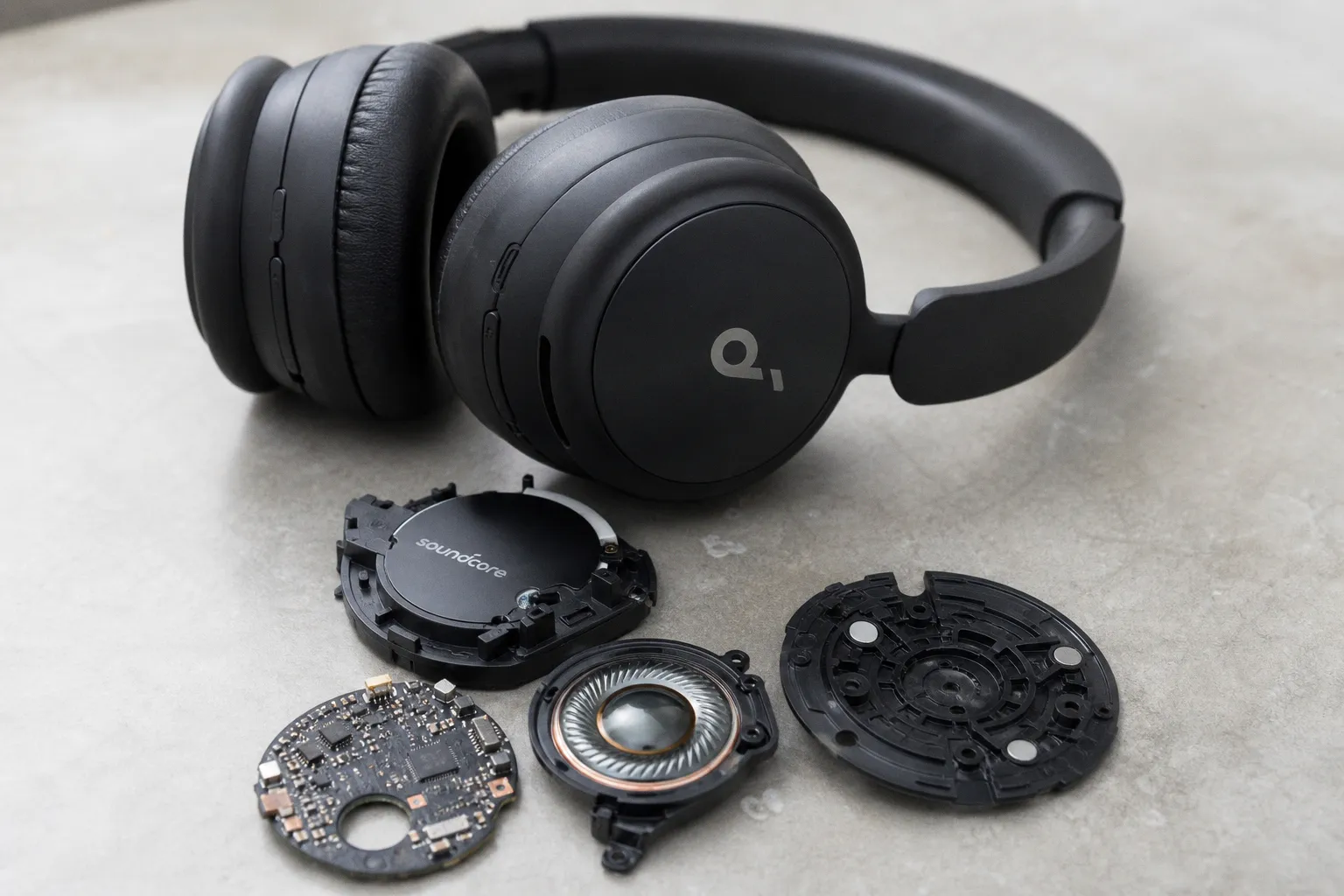
Active noise cancellation has a cost floor. Microphones, DSP, battery capacity, acoustic chamber design, and firmware tuning all consume bill-of-materials budget. Cheap headphones can include an ANC switch and still perform poorly. Good value noise cancelling headphones do not win by using cheaper parts alone. They win by placing cost in the parts that affect measured performance.
Hybrid ANC is the baseline. It uses feedforward microphones outside the earcup and feedback microphones inside the cup. Feedforward systems detect external sound before it reaches the ear. Feedback systems monitor residual sound inside the chamber. The hybrid approach covers a broader frequency range and corrects more errors than feedforward-only designs.
That matters because budget ANC failures are usually not subtle. They show up as:
- Weak suppression below 200 Hz, where engine rumble and HVAC noise sit.
- Audible hiss from the noise-cancelling circuit.
- Pressure artifacts during quick head movement.
- Poor wind handling in outdoor mode.
- A narrow cancellation band that works only on steady low-frequency noise.
The Soundcore Anker Life Q30 remains a useful benchmark because it put hybrid ANC, multiple cancellation profiles, and long battery life into the sub-$80 class. Its Transport, Indoor, and Outdoor modes are not decorative labels. They indicate different ANC tuning targets. Transport mode typically prioritizes low-frequency attenuation. Indoor mode tends to focus on steady room noise and speech leakage. Outdoor mode has to manage wind and variable noise.
Sony’s WH-CH720N shows the other route. It uses Sony’s V1 processor, the same noise-cancelling chip family found in the WH-1000XM5 line, inside a lighter and lower-cost chassis. That does not make the WH-CH720N equal to Sony’s flagship. The acoustic seal, microphone array, driver platform, and tuning still differ. But the DSP foundation gives Sony a credible base in the mid-range class.
The value tier is not a flagship replacement. It is a component-allocation exercise. Good models spend on DSP, microphones, battery, and fit before premium trim.
The first filter is therefore simple. If a headphone does not use hybrid ANC, it needs a large price discount or a specific non-ANC advantage. Feedforward-only ANC may be acceptable for light commuting. It should not be priced like a complete ANC platform.
Decoding the ANC-to-cost ratio in modern audio gear
ANC-to-cost is not a formal industry metric. It is still the most useful buying lens for this category. It forces the comparison away from brand hierarchy and toward measured utility.
A practical ANC-to-cost evaluation has four columns: price band, ANC architecture, battery life with ANC on, and secondary capability. Secondary capability means LDAC, multipoint, app EQ, low weight, or strong call noise reduction. A low-cost headphone with one strong metric can still be a poor buy if it fails the other three.
| Model class / example | Typical price band | ANC platform | Battery with ANC on | Main value lever | Main constraint |
|---|---|---|---|---|---|
| Soundcore Anker Life Q30 | Under $80 | Hybrid ANC with selectable modes | Around value-class long endurance | Low entry price with useful ANC modes | Materials and pad durability are not premium-grade |
| Sony WH-CH720N | $100–$200 | ANC using Sony V1 processor | Competitive mid-range endurance | Strong DSP pedigree in light chassis | Not equivalent to WH-1000XM5 isolation or tuning |
| 1More SonoFlow | Often below $100 | Budget ANC platform | Competitive value-class endurance | LDAC and Hi-Res Audio Wireless support | Codec support does not guarantee superior tuning |
| Generic low-cost ANC headset | Under $60 | Often feedforward or weak hybrid | Variable | Low purchase price | ANC hiss, weak seal, poor firmware support |
This table is intentionally narrow. It excludes premium flagships because the value question changes above $250. In that tier, buyers pay for better microphones, stronger passive isolation, more refined ANC algorithms, better transparency mode, superior hinges, and lower acoustic artifacts. Those gains exist. They are not always proportional to price.
For the value segment, the correct target is 80–90% of the useful daily feature set at a lower cost, not 100% of flagship silence. Claims of flagship-equivalent cancellation in sub-$100 hardware should be treated as marketing. Manufacturers rarely publish standardized attenuation curves for budget models. Without third-party lab measurements, exact decibel reduction claims are not comparable.
A useful purchase screen looks like this:
1. Start with ANC architecture. Hybrid ANC is the minimum for serious use. If the listing does not state the microphone arrangement, assume the implementation is limited until measurements prove otherwise.
2. Check battery life with ANC enabled, not disabled. Value leaders now sit around 35–50 hours with ANC on. Battery claims without ANC are less relevant because they describe a different product state.
3. Confirm Bluetooth version and multipoint behavior. Bluetooth 5.2 or newer is the practical target. Multipoint that drops audio during laptop-phone switching is a firmware liability, not a convenience feature.
4. Look for app-level EQ. Budget tuning can be uneven. App EQ provides correction range. It cannot fix driver distortion or poor cup acoustics, but it can reduce obvious bass bloom or treble glare.
5. Treat Hi-Res labels as secondary. LDAC support can be useful. Driver quality, seal, and tuning still determine the listening result.
6. Check weight and clamp reports. Under 250 g is preferred for long sessions in budget over-ear headphones. A light shell with bad clamp geometry still fails.
This method also prevents a common buying error: selecting by discount percentage. A headphone reduced from $180 to $90 is not automatically better than a model designed well at $80. The relevant question is not list price. It is current price against measured function.
Battery longevity and connectivity standards for value seekers
Battery life is one area where good value noise cancelling headphones can outperform expensive models. Premium headphones often prioritize lower weight, smaller housings, and more complex processing. Budget and mid-range over-ear models can allocate more volume to battery cells and still remain under common comfort limits.
The current value standard is clear: 35–50 hours with ANC turned on. Below 30 hours, the device needs compensating strengths. Above 50 hours, the claim deserves scrutiny but may be plausible if the headphone uses efficient drivers, conservative amplification, and a larger cell.
Battery testing should separate four states:
| Test state | Why it matters | Value-tier expectation |
|---|---|---|
| ANC on, music playback | Primary real-world state | 35–50 hours is competitive |
| ANC off, music playback | Shows platform efficiency | Higher than ANC-on result, but less important |
| ANC on, no music | Useful for flights or office noise | Should not drain aggressively |
| Multipoint connected | Stresses radio and firmware | Should not cause unstable drain or dropouts |
The drain curve matters more than the headline. A headphone that reports 60% battery for hours and then drops quickly is poorly calibrated. It may still run long, but the gauge is less useful. This affects travel and work use because charge planning depends on predictable reporting.
Charging speed is also part of value, but it is often overstated. Fast-charge claims are usually measured under ideal conditions. The relevant metric is not “minutes of playback from minutes of charging” in isolation. It is whether the device can recover enough capacity during a short break without thermal stress or battery gauge confusion.
Connectivity has become more important since multipoint moved into cheaper hardware. Bluetooth 5.2 or later is recommended because it usually brings better link stability and power behavior when implemented well. The version number alone is not proof. Firmware quality decides whether laptop video calls, phone notifications, and music playback switch cleanly.
The value buyer should separate three connectivity features:
- Multipoint pairing: connects to two devices at once. Useful only if handoff is stable.
- Codec support: SBC and AAC cover baseline use. LDAC adds higher-bitrate Android support when conditions allow.
- App control: required for ANC mode switching, EQ, firmware updates, and sometimes wear detection settings.
A weak app can reduce the value of strong hardware. If ANC profiles, EQ, and updates are locked behind unstable software, the headphone becomes harder to maintain. This matters over two to three years, especially for products bought to avoid frequent replacement. Long device planning resembles any other cost-control decision; the same logic behind long-term savings goals applies at a smaller scale when the buyer chooses durable gear instead of repeat low-grade purchases.
High-resolution audio and codec support in budget hardware
The 1More SonoFlow is notable because it brings LDAC and Hi-Res Audio Wireless certification into the budget class, often below $100. That is a real specification advantage. It is not a guarantee of better sound.
LDAC can transmit at higher bitrates than SBC and AAC under suitable conditions. It requires a compatible source device, usually Android. It also requires enough radio stability. In congested RF environments, high-bitrate modes can fall back or become less reliable. A codec cannot override driver limitations, cup resonance, or poor tuning.
The correct audio hierarchy is:
1. Driver and acoustic design.
2. Seal consistency.
3. Frequency response tuning.
4. Distortion behavior at normal and high SPL.
5. Codec and source quality.
6. App EQ flexibility.
Budget headphones often tune for elevated bass because it creates an immediate sense of body and masks thin driver behavior. That can work for commuting. It can also blur low-mid detail and make ANC pressure more obvious. A neutral or mildly warm tuning is usually easier to correct than a deeply V-shaped response with sharp treble peaks.
Hi-Res certification should be read as a capability label. It tells the buyer that the signal path supports certain criteria. It does not say the headphone produces accurate playback. The same applies to large driver diameter. A 40 mm driver is common. It says little without measurements.
For ANC headphones, sound quality also changes by mode. Some models alter DSP when ANC is enabled. Others sound different in transparency mode. The better value products keep tonal balance consistent across modes. The weaker ones deliver acceptable sound only with ANC off, which defeats the core purchase reason.
Codec selection should follow device ecosystem:
| Source device | Practical codec priority | Buying implication |
|---|---|---|
| iPhone or iPad | AAC stability | LDAC is not useful on iOS |
| Android phone with LDAC | LDAC plus app EQ | 1More SonoFlow-type feature sets gain value |
| Windows laptop | SBC/AAC behavior varies by stack | Multipoint stability may matter more than codec |
| TV or streaming box | Latency and pairing stability | ANC and comfort often outrank Hi-Res labels |
Latency is not always published cleanly. Video apps can compensate. Games usually expose delay. If the buyer needs gaming performance, a general-purpose ANC headphone is not the cleanest tool unless it has a verified low-latency mode or wired operation with acceptable behavior.
Comfort, seal, and build: the parts that decide ANC performance
ANC depends on passive isolation. The microphone system cannot fully compensate for a poor seal. Glasses, hair, jaw movement, pad depth, and clamp force all affect low-frequency leakage. This is where spec sheets fail.
Weight under 250 g is preferred for long-term comfort in the value class. The Sony WH-CH720N is positioned as a lightweight ANC headphone, which is part of its appeal. But weight is only one axis. Clamp distribution and pad surface area matter as much.
A budget headphone can feel light and still become fatiguing if the headband creates a narrow pressure point. It can also measure well on battery and fail physically because the synthetic leather pads crack after moderate use. Long-term durability of synthetic leather ear pads in budget models is not standardized across brands. It should not be assumed equal to premium pads.
The physical evaluation should be blunt:
- Earpad opening: if the ear touches the driver fabric, heat and pressure increase.
- Clamp force: too low reduces seal; too high creates jaw fatigue.
- Hinge design: thin plastic yokes are a failure point in low-cost over-ears.
- Pad replaceability: replaceable pads extend product life and preserve ANC performance.
- Button layout: physical buttons are easier to operate blind than inconsistent touch panels.
- Microphone ports: exposed ports can collect dust and affect ANC behavior.
Build quality also affects acoustic consistency. A flexible cup shell can create slight fit variation. Weak hinges can alter clamp over time. Pad compression reduces passive isolation, which forces the ANC system to work against more leakage. This is why two-year value can differ from day-one value.
ANC is not only an algorithm. It is a seal, a pad material, a hinge tolerance, and a battery curve.
Transparency mode should be assessed separately from ANC. Budget transparency often sounds processed or narrow-band. It may be adequate for announcements and short conversations. It usually will not match premium models that use stronger microphone arrays and cleaner DSP. If transparency quality is a priority, the buyer should expect to move up the price ladder.
Call quality is another separate subsystem. The 2023–2026 product window has brought more AI-driven noise suppression into affordable headphones. Performance still varies sharply. Voice isolation in keyboard noise, wind, and street traffic is not the same as ANC for the listener. A headphone can cancel cabin rumble well and still transmit a compressed, unstable voice on calls.
Comparing the likely buys: sub-$80, under-$100 LDAC, or $100–$200 Sony
The value segment has three rational routes.
The first is the sub-$80 ANC benchmark route, represented by Soundcore Anker Life Q30. This is the price-first option. It makes sense when the buyer wants working hybrid ANC, long runtime, and app-based modes without paying for premium finish. The risk is material aging and less refined sound or transparency behavior.
The second is the under-$100 codec-heavy route, represented by 1More SonoFlow. This is stronger for Android users who can use LDAC and want Hi-Res Audio Wireless support. It makes less sense for iPhone users, where AAC is the practical ceiling. The risk is overvaluing codec support while ignoring tuning and seal.
The third is the $100–$200 DSP route, represented by Sony WH-CH720N. This route pays more for Sony’s ANC processing background and a lightweight chassis. It is not a discounted WH-1000XM5. It is a mid-range Sony with selected technology transfer. The risk is assuming chip commonality equals total system equivalence.
A direct decision table is cleaner than a brand ranking:
| Buyer priority | Better fit | Reason |
|---|---|---|
| Lowest credible ANC cost | Soundcore Anker Life Q30 class | Hybrid ANC and mode control below typical mid-range pricing |
| Android high-bitrate playback | 1More SonoFlow class | LDAC support below $100 increases codec value |
| Lightweight mainstream ANC | Sony WH-CH720N class | V1 processor and low-weight design target daily use |
| Best possible silence | Skip value tier | Premium Bose or Sony flagships still lead on total ANC systems |
| iPhone music quality per dollar | Codec-heavy models lose advantage | AAC stability and tuning matter more than LDAC |
| Long battery with ANC | Value over-ear class generally | 35–50 hours with ANC on is common among value leaders |
The skip conditions are also data-based. Skip a model if it lacks hybrid ANC at a mid-range price. Skip if the manufacturer quotes battery life only with ANC off. Skip if the app has no EQ and the stock tuning is heavily colored. Skip if the weight is reasonable but the pads are shallow. Skip if multipoint is advertised but user testing shows frequent handoff failures.
The buy conditions are narrower. Buy when the current price matches the tier, the ANC system is hybrid, battery life with ANC on is inside the 35–50 hour value range, and the feature set matches the source device. Android users can value LDAC. iPhone users should not pay extra for it. Frequent callers should prioritize microphone tests over codec labels. Long-session users should prioritize weight, pad depth, and clamp.
Verdict: buy the system, not the discount
Good value noise cancelling headphones are no longer defined by a single cheap model with acceptable ANC. The category now has several viable configurations. The correct purchase depends on which subsystem carries value for the buyer: ANC architecture, battery life, codec support, weight, or DSP pedigree.
The data supports a simple verdict. Buy in the under-$100 tier if hybrid ANC, 35–50 hours of ANC battery life, and app control are present. Move into the $100–$200 tier when lower weight, stronger DSP, or better multipoint behavior is documented. Skip any model that sells feedforward-only ANC, vague battery claims, or Hi-Res branding without evidence of competent tuning.
The practical target is not flagship silence. It is controlled noise reduction, stable battery endurance, usable comfort, and source-appropriate audio at a price that does not punish replacement parts or normal wear. On that basis, the strongest value buys are the ones with balanced engineering. Not the ones with the loudest discount.