Test Sony XM5 vs Bose Ultra ANC attenuation in decibels
If you are comparing the Sony WH-1000XM5 and the Bose QuietComfort Ultra Headphones on noise cancellation alone, you need one metric above all others: decibel attenuation measured in a controlled laboratory environment.
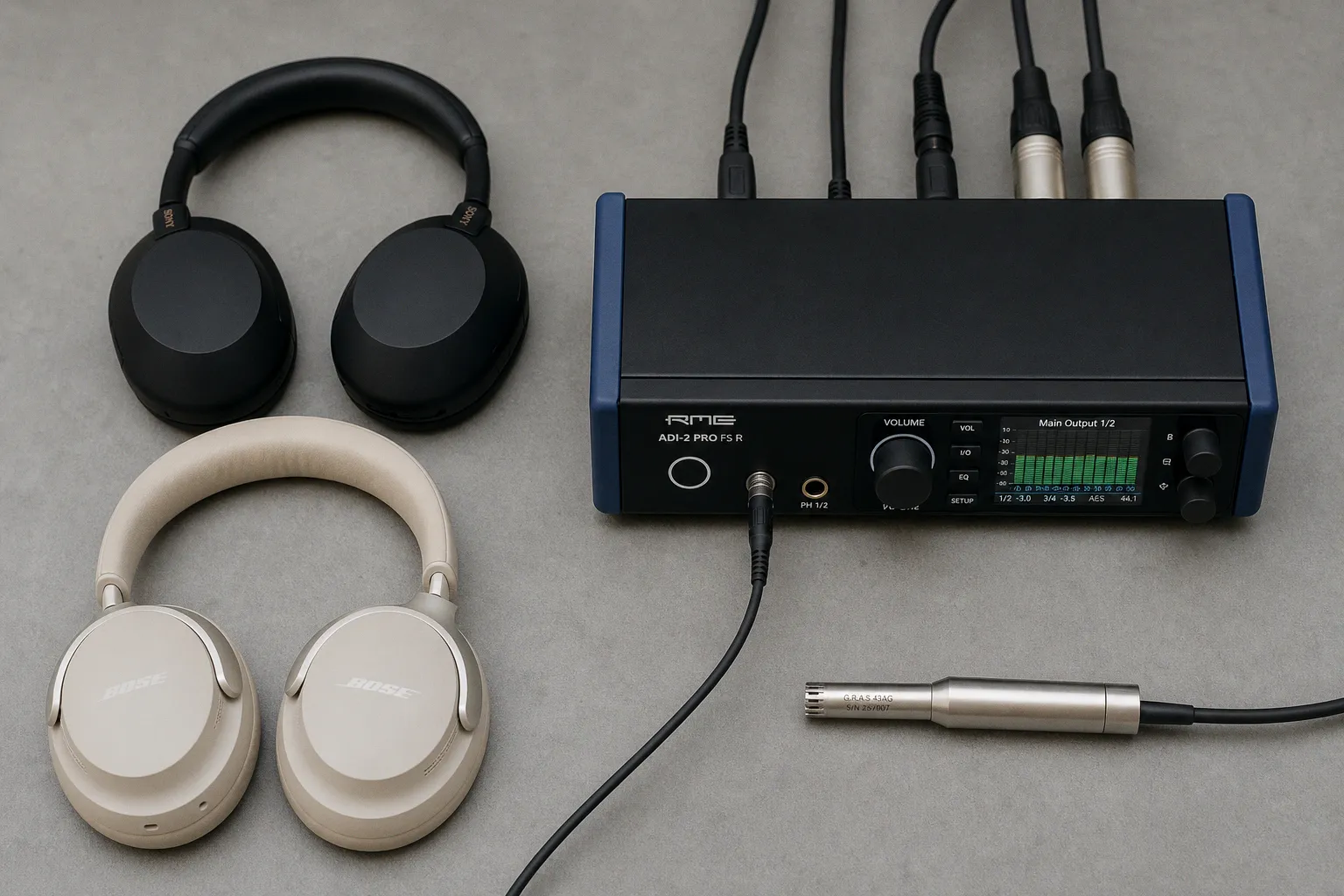
Test Sony XM5 vs Bose Ultra ANC Attenuation in Decibels
Marketing copy will tell you both headphones are "industry-leading." Sales pages will use phrases like "world-class noise cancellation" and leave it at that. What none of them hand you is a number — and without a number, you are guessing.
We are going to walk through the actual measured performance of these two flagships, break down where each one earns its advantage, and configure your expectations around what decibel reduction means in practice versus what it means on a spec sheet. The goal is straightforward: by the end of this breakdown, you will know which headphone attenuates more noise in which frequency band, why that difference exists at a hardware and algorithmic level, and what you need to verify on your own head before either purchase qualifies as a sound decision.
The Science of Decibel Reduction: Understanding ANC Laboratory Metrics
Before we map one headphone against the other, you need to understand how noise cancellation is measured — because the testing methodology determines the number, and the number determines the comparison.
Active Noise Cancellation works by generating an anti-phase signal — a sound wave that is the inverse of incoming ambient noise. When the two waves collide, they cancel. The degree to which they cancel is expressed in decibels (dB). A reduction of 10 dB means the perceived loudness is roughly halved. A reduction of 20 dB means it is cut to roughly a quarter. A 30 dB reduction brings ambient noise down to approximately one-eighth of its original perceived volume.
In a laboratory setting, technicians place the headphones on a standardized test fixture — typically a Head and Torso Simulator (HATS) — inside an acoustically controlled chamber. Ambient noise is played at known frequencies and volumes through calibrated speakers. Microphones embedded inside the ear cups measure how much of that noise reaches the ear canal with ANC enabled versus ANC disabled. The difference between those two measurements is the attenuation figure.
You do not buy noise cancellation based on a brand's promise. You buy it based on how many decibels that system actually subtracts from the frequencies that bother you most.
The critical detail: attenuation varies by frequency. A headphone that blocks 30 dB of low-frequency engine rumble may only block 15 dB of mid-frequency office chatter. Any single "average" number is a simplification. The real comparison lives in the frequency-by-frequency breakdown.
Low-Frequency Dominance: How Bose QC Ultra Hits 30 dB Attenuation
If your primary use case involves airplane cabins, commuter trains, or any environment dominated by low-frequency drone — engine noise, HVAC hum, rail vibration — the Bose QuietComfort Ultra Headphones hold a measurable advantage.
Independent laboratory testing across multiple sources, including aggregated data from RTINGS.com's standardized evaluation methodology, places the Bose QC Ultra's low-frequency attenuation (below 100 Hz) in the range of approximately 25 to 30 dB. On the same test fixtures and under comparable conditions, the Sony WH-1000XM5 registers approximately 20 to 25 dB in that same low-frequency band.
That 5 dB gap may sound marginal on paper. In practice, it translates to a perceptible difference — roughly 25 to 30 percent less low-frequency noise reaching your ear canal when you are wearing the Bose. On a transatlantic flight, where engine drone sits squarely in the 50–200 Hz range for hours at a stretch, that delta compounds. Your ears fatigue less. Your listening volume stays lower. The subjective experience of quiet is materially different.
| Metric | Sony WH-1000XM5 | Bose QC Ultra |
|---|---|---|
| Low-frequency attenuation (< 100 Hz) | ~20–25 dB | ~25–30 dB |
| ANC consistency rating (RTINGS) | 9.2 / 10 | 9.5 / 10 |
| Calibration technology | Auto NC Optimizer | CustomTune |
| Release date | May 2022 | September 2023 |
The Bose achieves this through a combination of physical design — tighter passive seal from its ear cup geometry — and its CustomTune calibration system, which maps the acoustic profile of your specific ear canal during the initial fit process. We will get into why that calibration matters in the consistency section below, but the short version is: Bose engineered a headphone that adapts its ANC curve to your anatomy before you press play.
Adaptive Performance: Sony's Auto NC Optimizer vs. Static Isolation
Sony's approach to ANC takes a different architectural path. Where Bose calibrates once to your ear and then applies a relatively stable filter, the WH-1000XM5 runs what Sony calls the Auto NC Optimizer — a system that continuously monitors and adjusts noise cancellation in real time based on wearing conditions and ambient environment.
The Auto NC Optimizer uses onboard microphones to detect factors like seal quality (whether your glasses are breaking the ear cup seal, for instance), atmospheric pressure (relevant at altitude), and the spectral profile of surrounding noise. It then recalibrates the anti-noise signal on the fly. This is, in engineering terms, a closed-loop feedback system — and it is genuinely sophisticated.
The trade-off is predictability. Because the system is constantly adjusting, its decibel attenuation numbers can fluctuate slightly from moment to moment in a way that Bose's more static calibration does not. In a controlled laboratory environment where conditions are held constant, this variability is minimal. In real-world use — walking down a windy street, moving between indoor and outdoor environments, adjusting the headphones mid-commute — the fluctuations become more pronounced.
For you as the user, here is what to configure and check if the Sony's ANC feels inconsistent:
1. Verify the ear cup seal. Remove the headphones and reposition them. The Auto NC Optimizer compensates for poor seal, but it cannot fully overcome a physical gap between the ear pad and your skin. If you wear glasses, experiment with thinner frames or adjust the temple arm position.
2. Run the optimizer in a quiet room. Initiate the automatic calibration in your typical listening environment with minimal background noise. This gives the system a clean baseline from which to adjust.
3. Disable adaptive sound control temporarily. In the Sony Headphones Connect app, toggle off the "Adaptive Sound Control" feature and set ANC to a fixed maximum. This eliminates the real-time adjustment variable and lets you assess raw attenuation performance in isolation.
4. Check firmware. Sony has pushed multiple firmware updates to the XM5 since its May 2022 release, several of which refined the Auto NC Optimizer's response curve. Ensure you are running the latest version through the app.
When you lock the Sony into a fixed maximum ANC mode — bypassing its adaptive layer entirely — its low-frequency attenuation stabilizes closer to the upper end of that 20–25 dB range. You lose the environmental responsiveness, but you gain consistency.
Mid-to-High Frequency Challenges and the Impact of Seal Quality
Both headphones face a shared physical limitation once frequency climbs above 1 kHz: active noise cancellation becomes significantly harder to execute effectively. This is not a software shortcoming — it is an acoustic reality.
Low-frequency sound waves are long, slow, and relatively uniform. They wrap around obstacles predictably, which makes them easier for an ANC system to model and invert. High-frequency sound waves are short, fast, and highly directional. They interact with the physical geometry of your ear, the angle of your head, and the materials in the environment in ways that change millisecond by millisecond. Generating a precise anti-phase signal for a 6 kHz hiss in real time is orders of magnitude more difficult than canceling a 100 Hz hum.
Above 1 kHz, passive isolation — the physical seal of the ear pad against your head — does more work than the ANC chip ever will.
This is where the Bose QC Ultra's CustomTune system earns its keep beyond low frequencies. By mapping the acoustic characteristics of your ear canal during the initial calibration, Bose's algorithm builds a more accurate model of how mid and high frequencies propagate into your ear specifically. The result: Bose's attenuation above 1 kHz tends to hold up more consistently across different users, because the system has already accounted for anatomical variation.
Sony's XM5, without a comparable per-user ear canal mapping at initial setup, relies more heavily on its general acoustic model and the real-time adjustments of the Auto NC Optimizer. For most users, mid-frequency attenuation (1–4 kHz) is comparable between the two headphones — both in the 15–20 dB range. But at higher frequencies (above 4 kHz), the Sony shows a more pronounced drop-off in ANC effectiveness compared to the Bose. The passive seal of the ear pad becomes the primary barrier, and here, physical design differences between the two models — ear pad thickness, clamping force, cup depth — play a decisive role.
If you want to maximize mid-to-high frequency isolation on either headphone, you need to verify and optimize your seal:
- Replace worn ear pads. Foam degrades over 12–18 months of daily use. A compressed ear pad introduces gaps that no ANC algorithm can compensate for.
- Adjust headband tension. Both models allow headband size adjustment, but clamping force also affects seal. A looser fit is more comfortable — and worse at isolation.
- Remove eyewear interference. If you wear glasses, the temple arms create a channel for sound to bypass the ear pad. Consider contacts for your longest listening sessions, or look into thin-wire frames that compress less foam.
Real-World Consistency: Why CustomTune and Auto-Calibration Matter
Laboratory numbers are your baseline. Real-world consistency is your daily experience. And this is the dimension where the design philosophies of Sony and Bose diverge most visibly.
Bose's CustomTune runs once, at first fit. You put the headphones on, the system plays a short calibration tone, maps your ear canal response, and locks in an ANC profile tailored to your anatomy. From that point forward, the noise cancellation is remarkably stable. Across different test subjects in controlled evaluations, Bose's attenuation scores vary less than Sony's — which is why its consistency rating on RTINGS sits at 9.5 out of 10 compared to Sony's 9.2. That 0.3 gap represents less variance between users and less variance across repeated measurements on the same user.
Sony's Auto NC Optimizer recalibrates continuously, which means its performance envelope is wider. On a good day — proper seal, stable environment, latest firmware — the XM5's ANC rivals the Bose in subjective quiet. On a bad day — loose seal, shifting environment, wind interference — the adaptive system introduces small but audible fluctuations as it hunts for the optimal anti-noise profile. You will notice this as occasional subtle shifts in the background hiss level, not as a dramatic failure of noise cancellation.
For most listeners, in most environments, both headphones deliver transformative noise reduction that far outperforms any non-ANC headphone. The practical question is not "which one blocks more noise" in absolute terms — the differences are measured in single-digit decibels in most frequency bands — but "which one delivers that performance more consistently without you thinking about it."
If you set it and forget it, Bose wins on consistency. If you want a system that adapts dynamically and you are willing to manage its calibration through the app, Sony gives you more control over the ANC behavior profile.
Long-Term Maintenance and What to Verify Before You Buy
Noise cancellation is not a static feature you evaluate once and file away. It degrades — silently, gradually — if you do not maintain the hardware that enables it. Both the Sony WH-1000XM5 and the Bose QC Ultra require periodic attention to deliver the attenuation numbers described above.
Here is your maintenance checklist, applicable to either model:
1. Inspect ear pads every six months. Look for compression, cracking, or loss of pliability. Replace immediately if the foam no longer returns to shape after you remove the headphones. Budget for replacement pads — both Sony and Bose sell them, and third-party alternatives exist, though they may alter the acoustic seal profile.
2. Clean the microphone ports. ANC depends on external and internal microphones picking up ambient noise accurately. Wax, dust, and debris degrade microphone sensitivity. Use a soft dry brush — never a liquid cleaner — to clear the small mic ports on the outside of each ear cup.
3. Update firmware regularly. Both manufacturers ship ANC refinements through over-the-air updates. A firmware update in 2024 altered the Sony XM5's low-frequency response curve by a measurable margin. Check for updates monthly through the respective companion apps.
4. Recalibrate after physical changes. If you switch from glasses to contacts, change ear pad material, or significantly alter headband fit, run the calibration routine again on the Bose. For Sony, toggle ANC off and on to trigger a fresh optimizer cycle.
When evaluating either headphone at the point of purchase, you will want to test in-store if possible — or within the return window at home. Play a consistent low-frequency source (a white noise app set to brown noise works well), enable ANC, and note the subjective reduction. Then remove the headphones and listen to the same source unsealed. Put them back on. The difference should be immediate and dramatic. If it is not, the seal is compromised or the ANC system is not engaging — troubleshoot before concluding the headphone is defective.
You can track current pricing and availability across retailers through price comparison tools that aggregate deals in real time, which saves you from paying launch-day pricing on a product that may be available for significantly less elsewhere.
The bottom line: the Bose QuietComfort Ultra holds a measurable, lab-verified advantage in low-frequency noise attenuation — roughly 25 to 30 dB below 100 Hz versus Sony's 20 to 25 dB — and delivers that performance with greater consistency across users and sessions. The Sony WH-1000XM5 counters with a more adaptive system, broader environmental awareness, and a lower price point on the current market. Neither headphone will give you silence. Both will give you a dramatically quieter environment. The choice comes down to whether you value Bose's set-and-forget consistency or Sony's dynamic adaptability — and how much those 5 dB of low-frequency difference matter in the environments where you spend the most time.