Misophonia relief: why ANC headphone effectiveness is increasing
Noise cancelling headphones for misophonia are getting technically better. That does not make them a treatment.
The distinction matters because the market is already trying to sell “adaptive” and “AI-powered” noise control as if it can delete a specific person’s chewing, sniffing, breathing, or pen clicking on command. It cannot.
What has improved is the hardware stack: more microphones, faster processing, and ANC systems that react to changes in fit and surrounding noise. That raises the odds that a pair of headphones can make a train, HVAC system, aircraft cabin, or office drone less exhausting. For someone with sound sensitivity, that reduction can create useful breathing room.
But misophonia is not simply a volume problem. A 2022 expert consensus defined it as decreased tolerance to particular sounds or associated stimuli. The reaction is tied to the sound’s pattern or meaning, not loudness alone. A faint chewing sound may be more disruptive than a much louder engine. That is where the advertising copy runs into physics.
Modern ANC is no longer a one-microphone trick
The old version of active noise cancellation was straightforward. A microphone picked up outside noise, the headphones generated an opposing signal, and the system did its best with steady low-frequency rumble. It worked. Sometimes. The limits were obvious.
Current premium ANC uses a more expensive setup: hybrid microphone arrays and adaptive processing.
A hybrid system uses:
- Feedforward microphones outside the ear cup or earbud, listening to noise before it reaches the ear.
- Feedback microphones inside the cup or ear canal, measuring what still leaks through after the initial correction.
- Processing hardware that adjusts the cancellation signal as the acoustic environment changes.
- Fit detection or optimization, which attempts to compensate when the seal changes because of glasses, hair, a hat, jaw movement, or a shifted earbud.
That last item is not decorative engineering. A broken seal is where a premium ANC purchase starts depreciating in real time. If the ear cup lifts slightly off the skin or an ear tip does not fit the canal, external sound leaks in directly. The processor cannot fully reverse a physical gap.
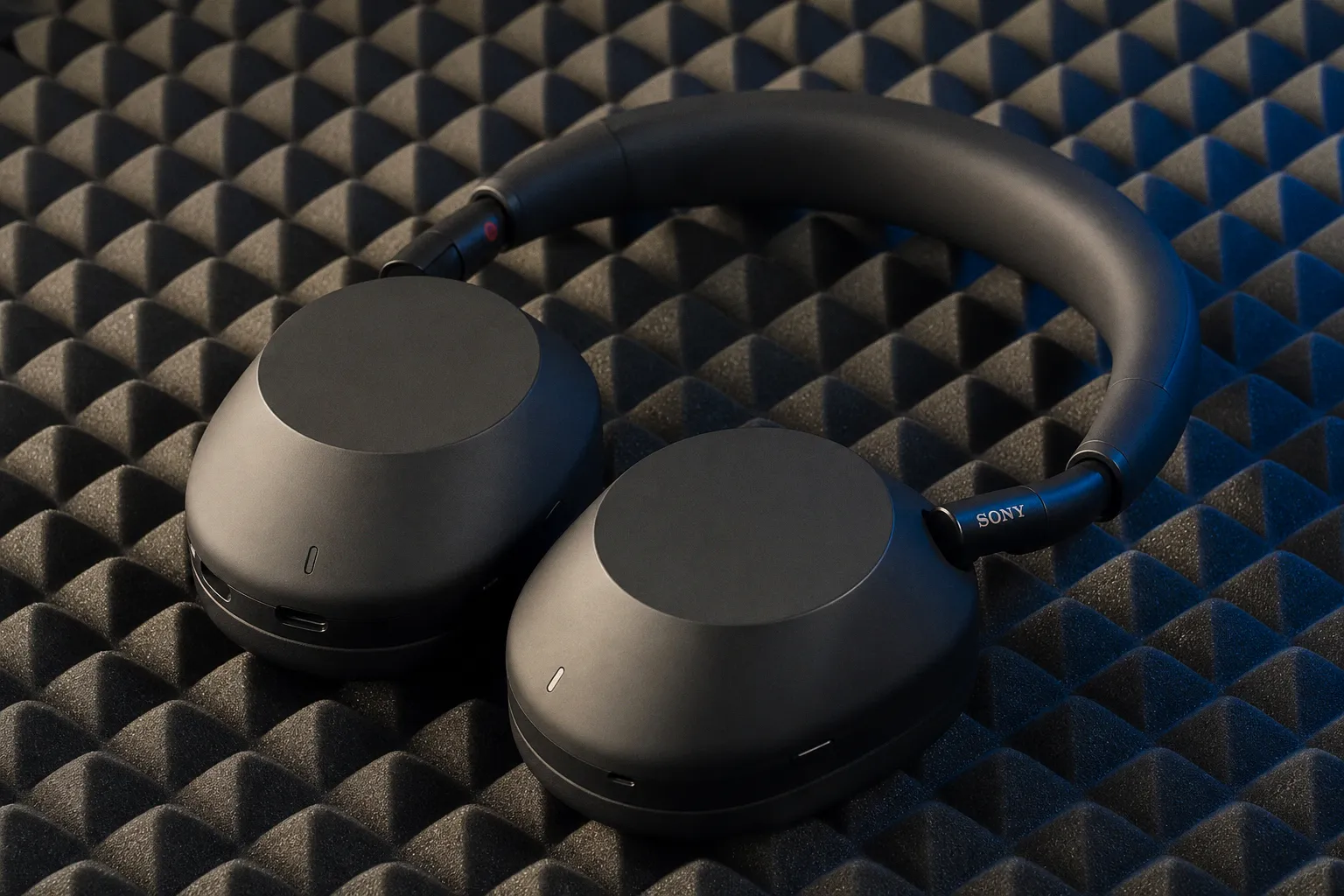
Sony’s WH-1000XM6 is a clean example of where the category is heading. Sony says it uses 12 microphones tuned in real time, driven by an HD Noise Cancelling Processor QN3 that it claims is seven times faster than the preceding processor. Its Auto NC Optimizer is designed to assess wearing conditions and the environment continuously.
The useful takeaway is not that “seven times faster” equals seven times more relief. It does not. The useful takeaway is that ANC now has more data to work with when the wearer moves from a quiet room to a bus, then into a café, then outside into wind.
This is genuine progress. It is also a familiar premium-audio sales tactic: take a real technical increment and price it as a universal solution.
Better ANC reduces more of the environment. It does not understand which sound is ruining your day.
Why trigger sounds are a hard target for ANC
Active noise cancellation is strongest against low- and mid-frequency noise that is relatively predictable. Engine rumble. Air-conditioning. Ventilation fans. The long, blunt sonic costs of modern life.
Misophonia triggers often sit at the opposite end of the problem.
They can be brief, irregular, human-generated, and rich in higher-frequency detail. Chewing is not one stable tone. It is a changing mix of transients, mouth sounds, small impacts, and pauses. Tapping has abrupt attack. Sniffling and breathing vary in timing and distance. Speech is even harder because it changes constantly and carries linguistic meaning.
ANC needs time to detect sound, calculate a response, and deliver that response. That process is extremely fast, but physics still gets a vote. Sudden, close, complex sounds are not the easy workload.
The phrase “active noise cancellation for chewing sounds” therefore needs a correction. ANC may reduce some background texture around the sound. It may soften part of the low-frequency component. It will not reliably erase chewing, while preserving every other useful sound, across rooms and people.
The same applies to “ANC for trigger sounds.” There is no consumer setting that identifies your exact trigger profile and removes only those sounds. Some products offer adaptive modes, conversation awareness, transparency modes, or broad environmental tuning. Those features are about sound management, not clinical targeting.
| Sound scenario | What ANC can often reduce | What requires passive isolation | What remains unreliable |
|---|---|---|---|
| Aircraft or train travel | Engine and cabin rumble | Higher-frequency cabin chatter | Sudden announcements and nearby speech |
| Office HVAC and equipment | Fan noise, air movement, low mechanical hum | Keyboard clicks and distant voices | One colleague’s repetitive tapping |
| Café ambience | Low crowd wash and appliance hum | Clinks, higher-pitched chatter, sharp impacts | Chewing, coughing, close speech |
| Shared home or dorm | Distant appliance noise | Door noise and room leakage | Breathing, sniffling, eating sounds nearby |
| Outdoor commuting | Some broad traffic rumble | Wind-related leakage and fit changes | Irregular honks, voices, abrupt sounds |
This does not mean headphones are useless for misophonia. It means the purchase must be scoped correctly. You are buying a tool that can lower environmental load. You are not buying a selective sound-removal system.
Passive isolation is the part buyers underprice
The market loves to talk about processors because processors have names. Seals do not. Yet for noise isolation for misophonia, the seal can matter more than a newer chip.
Passive isolation is the sound reduction created by the physical barrier between your ear and the world. With over-ear headphones, that means ear-pad depth, clamp force, pad material, cup geometry, and whether the pads actually sit flush around your ears. With earbuds, it means tip size, tip material, insertion depth, and the shape of your ear canal.
This matters most for higher-frequency sound. ANC is comparatively good at the low, steady stuff. A secure fit is what blocks more of the sharper detail that tends to travel through leaks.
The downside is obvious. A tight seal can become uncomfortable over long sessions. Glasses can break the seal around the temples. Thick hair can interfere. Small ears can struggle with oversized cups. Some people cannot tolerate in-ear pressure or foam tips at all.
That is why the “best headphones for sound sensitivity” are not automatically the ones at the highest MSRP. A $400 flagship with poor fit is a bad deal. Its advertised ANC performance is stranded behind a leak. A less expensive model that seals comfortably for three hours may deliver more real-world reduction per dollar and more usable years before replacement.
Treat fit as an operating cost, not a minor preference.
The over-ear versus earbud calculation
Over-ear headphones and true-wireless earbuds solve different problems. Neither category wins by default.
| Ownership factor | Over-ear ANC headphones | ANC earbuds |
|---|---|---|
| Passive isolation | Depends heavily on pads and glasses seal | Can be very strong with correct ear tips |
| Low-frequency ANC | Usually excellent in premium models | Often strong, but varies more with fit |
| Comfort over long sessions | Better for many users, but can run warm | Less bulky, but may cause ear-canal fatigue |
| Portability | Poorer; case is larger | Better; easy to carry all day |
| Battery and longevity | Larger batteries, but pads may need replacement | Small batteries age faster; replacement is often the whole unit |
| Cost per year of ownership | Can improve if pads are replaceable and the battery lasts | Can deteriorate fast if battery wear ends the product after a few years |
There is the financial reality manufacturers prefer to blur. Earbuds can have a lower entry price, but their batteries are tiny and many are difficult or uneconomical to repair. Over-ear models cost more upfront, then may stay useful longer if the pads can be replaced and the battery remains serviceable.
That is the cost-per-year calculation. Ignore it and the apparent discount can be artificial markup in reverse: low entry price, short ownership life, repeat purchase.
Adaptive processing is raising the floor, not removing the ceiling
Sony’s current approach is one side of the category: large over-ear headphones with multiple microphones and fit-aware ANC adjustment. Apple’s AirPods Pro 3 show the same direction in a smaller form factor. Apple lists both Active Noise Cancellation and Adaptive Audio in its specifications.
Adaptive Audio is relevant because real listening environments are unstable. You walk outside. The noise profile changes. Someone starts speaking nearby. Your earbud shifts. A fixed ANC setting is less useful in those conditions than a system that can adjust.
Still, adaptive sound control comes with trade-offs.
First, adaptive modes may let more outside sound in by design. That can improve awareness, but it may be the opposite of what a wearer needs in a high-trigger setting.
Second, microphones are not magic. Wind, movement, and poor fit can degrade performance. A system can have 12 microphones and still lose to a broken seal.
Third, automatic behavior can be frustrating for users who need predictability. If a mode changes transparency or attenuation at the wrong moment, the feature has failed its practical job, even if it looked good in a product briefing.
For sound sensitivity, manual control often matters as much as adaptive intelligence. You want to know what the headphones will do when you enter a café, board a train, or sit in an open office. A stable full-ANC mode may be more useful than an automatic mode that keeps making judgment calls you did not ask for.
The real upgrade is consistency under changing conditions, not selective cancellation of human behavior.
Do not confuse relief management with treatment
The clinical line needs to remain clean. Consumer ANC headphones have not been established as a standalone treatment for misophonia in the evidence reviewed here.
The strongest identified treatment evidence is for cognitive behavioral therapy. A 2023 systematic review found 33 misophonia-specific treatment studies: one randomized controlled trial, one open-label trial, and 31 case studies. That is not a huge evidence base. But it is still a better clinical foundation than claims made on headphone product pages.
In the randomized trial, CBT reduced Amsterdam Misophonia Scale-Revised scores by an average of 9.7 points after three months, compared with 0.8 points for the waiting-list group. Thirty-seven percent of people receiving CBT were rated much or very much improved, versus none of the controls.
Headphones may still be part of a person’s day-to-day coping setup. The distinction is simple:
1. ANC can lower the baseline noise burden. This can make commutes, travel, shared workspaces, and other loud environments more manageable.
2. Passive isolation can reduce some sharper external detail. This depends on fit, not branding.
3. Masking audio can change the listening environment. But it should not become an excuse to run music or white noise at punishing levels.
4. Neither ANC nor masking audio has been shown here to resolve misophonia itself. They are tools for managing exposure, not replacements for professional care.
That last point matters because there is a bad incentive in this market. Headphone companies benefit when every difficult listening problem looks like a hardware upgrade cycle. Misophonia does not become a $450 checkout problem because a flagship model has more microphones.
Volume is the hidden bill
When external sound feels intrusive, the instinct is to turn something else up. Music. Brown noise. Rain tracks. Podcasts. That can be useful at moderate levels. It can also produce a second problem: excessive sound exposure.
The World Health Organization advises using well-fitted noise-cancelling headphones because they can reduce the need to increase volume in noisy places. Its practical cue is to keep device volume at no more than 60% of maximum, while recognizing that a volume percentage is not a precise universal safety limit. Device output varies. Headphone sensitivity varies. The recording itself varies.
Where exposure monitoring is available, the more useful target is an average below 80 dB. WHO’s reference point for adults is 80 dB for up to 40 hours per week. At 90 dB, the comparable safe listening time falls to four hours per week.
That is not a reason to obsess over one number on a phone screen. It is a reason to stop treating masking volume as free.
A competent ANC setup can help because it reduces the volume needed for whatever you choose to play. That is one of the clearest practical advantages of good noise cancellation. The point is not to drown out every trigger. The point is to avoid paying for relief with more sound exposure.
The buying timeline: buy the fit, not the launch hype
ANC headphone effectiveness is increasing in a narrow but meaningful way. Hybrid arrays, faster processors, and adaptive tuning produce better performance when noise, movement, and fit change throughout the day. Premium over-ear models such as the Sony WH-1000XM6 demonstrate that engineering shift. Adaptive features in earbuds such as AirPods Pro 3 show that the technology is spreading beyond large headphones.
But the ceiling remains in place. ANC cannot reliably isolate and delete close, irregular, human trigger sounds. It cannot diagnose or treat misophonia. And it cannot overcome a bad fit.
Buy now if your current headphones leak low-frequency noise, force you to raise volume, or have worn pads or tips that no longer seal. In that case, a fit-first upgrade has immediate utility. Test comfort before return windows close. Wear glasses if you normally wear glasses. Walk outdoors. Sit near a fan. Use the headphones in the places that actually cause trouble.
Wait if your present pair already seals well and your reason for upgrading is a claim that the latest adaptive ANC will eliminate chewing or other specific triggers. That claim has no reliable basis. Do not pay launch MSRP for a promise the hardware cannot keep.
The sensible purchase is not the loudest product release. It is the model that lowers your daily noise load, at a volume you can live with, for enough years to justify the depreciation.