Best budget wireless earbuds: our pass-fail quality verdict
The budget-earbud market has a pricing problem. Too many products start with inflated MSRP, attach "50 dB ANC" to the box, then rely on a $20 coupon to create the impression of a deal. That is not value.
Best budget wireless earbuds: our pass-fail quality verdict
It is retail staging.
The best budget wireless earbuds earn their place through boring, measurable things: noise reduction that works outside a product page, battery life that survives a commute, a fit that seals, and a price that leaves room for depreciation. In 2026, the line is simple. Under $100 is a viable market. Above it, a pair needs a clear performance advantage—not another codec logo.
Our pass-fail verdict is not a single universal winner. Ear shape, phone platform, calls, gym use, and preferred sound tuning still matter. But the field has clear leaders, clear caveats, and several claims that should stay on the shelf.
The reality of budget ANC: the decibel claim is not the product
Active noise cancellation is now the most abused number in cheap earbuds. Brands advertise 48 dB, 50 dB, sometimes more. The number looks authoritative. It is usually not comparable.
ANC performance changes with test method, ear-tip seal, the frequencies measured, and whether the brand reports a peak result or an average. A claimed maximum is not the same thing as the amount of subway rumble, office chatter, or HVAC hiss removed from your actual day.
CMF Buds 2 Plus is the clean example. It carries a $69 MSRP and advertises up to 50 dB of noise cancellation. Independent testing found up to 83% ambient-noise reduction. That is a strong result for the money. But the same testing found that the earbuds did not reach the advertised 50 dB figure and were weaker against low-frequency noise in the 50–100 Hz range.
That does not make the CMF pair a failure. It makes the 50 dB label a weak purchase signal.
The earbud that blocks the most sound in a controlled condition is not necessarily the pair that works best for you. Aircraft rumble, bus engines, human voices, keyboard clatter, and wind all sit in different parts of the frequency spectrum. A product can look excellent on one number and still leave the noise you hate largely intact.
Treat ANC decibels as advertising inventory, not as a standard of value.
Soundcore's Space A40 remains a serious budget benchmark because its street price has commonly hovered around $50 and independent testing rates its ANC as excellent—strong enough to outperform some more expensive alternatives. At that price, the product has a low cost basis. It does not need to be flawless. It needs to beat the next $50 spent.
The CMF Buds 2 Plus has a different proposition. It offers strong measured overall isolation at a $69 list price, but its low-rumble performance carries a real limitation. For commuters whose main problem is trains, buses, or airplane cabins, that limitation belongs in the purchase decision. Do not buy the headline. Buy the noise profile.
Performance benchmarks: EarFun Air Pro 4+ versus Soundcore Space A40
The two most defensible names in affordable true wireless earphones are not identical picks. That matters.
SoundGuys has named the EarFun Air Pro 4+ its top all-around option under $100. RTINGS has named the Anker Soundcore Space A40 its top budget choice. The disagreement is useful. It shows why "best" without conditions is a lazy label.
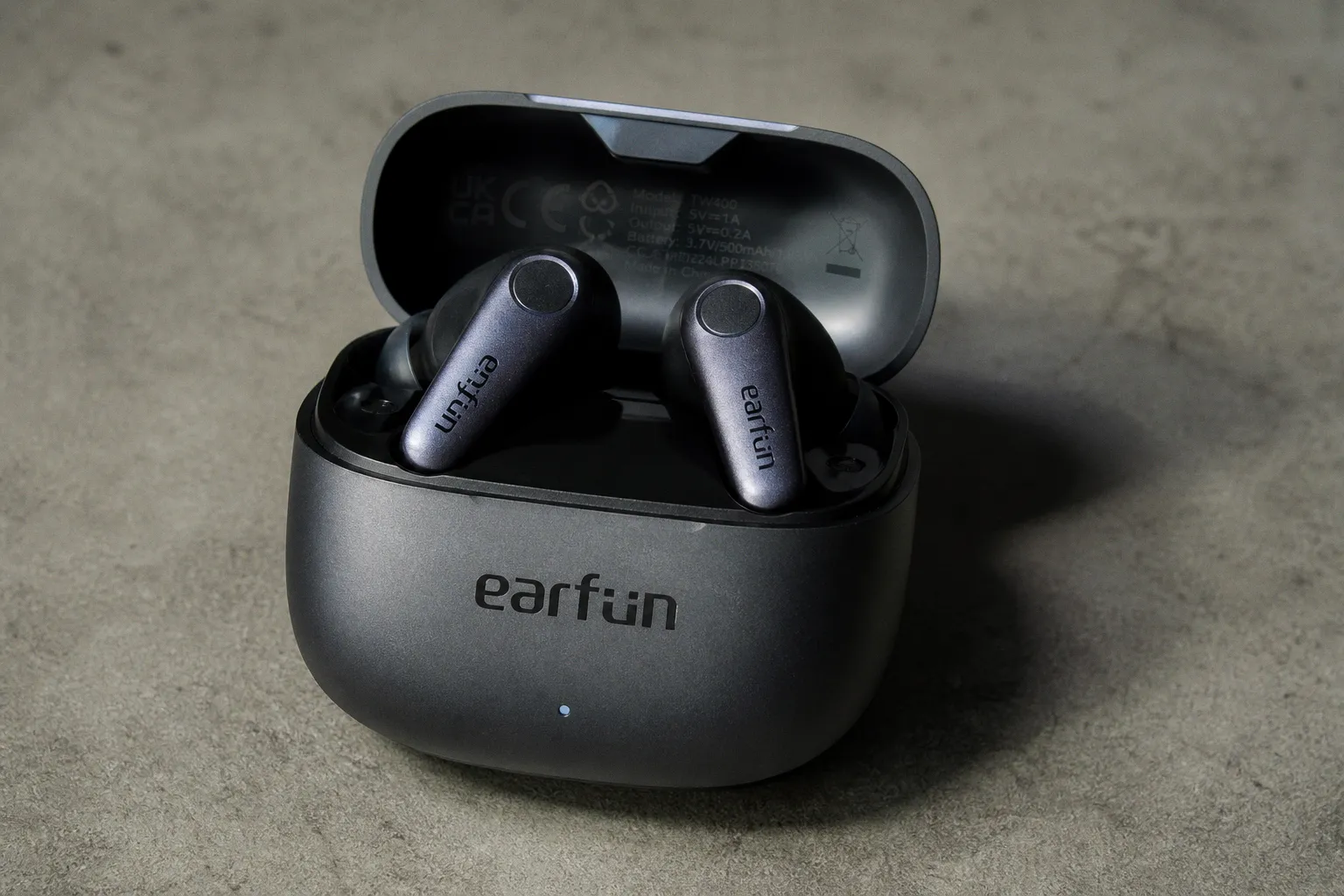
EarFun is the feature-heavy option. Its $99.99 MSRP puts it at the ceiling of the budget class, not in the cheap-basket aisle. In exchange, it brings Bluetooth 6.0, support for aptX Lossless, LDAC, and Auracast, dual drivers, an app-based EQ, IP55 dust and water resistance, and a measured average noise reduction of 80%.
Space A40 is the price-disciplined option. Its common street price around $50 is the core argument. It is half the outlay of EarFun at MSRP, while independent testing calls its ANC excellent. That is not a minor distinction. It is the difference between a replacement purchase that stings and one that does not.
| Parameter | EarFun Air Pro 4+ | Soundcore Space A40 |
|---|---|---|
| Price reference | $99.99 MSRP | Commonly around $50 street price |
| Independent budget-guide position | Top all-around sub-$100 pick from SoundGuys | Top budget pick from RTINGS |
| Noise cancellation | 80% average external-noise reduction in testing | Rated excellent in independent testing |
| Battery evidence | 6 hours 17 minutes measured with ANC on | No comparable measured figure in the available data |
| Connectivity pitch | Bluetooth 6.0, LDAC, aptX Lossless, Auracast | The value case is price and ANC, not a long feature list here |
| Protection rating | IP55 dust and water resistance | Not established in the available comparison data |
EarFun's extra feature set is real. It is not automatically valuable.
LDAC and aptX Lossless do not produce premium sound by declaration. Your phone, operating system, streaming service, source file, and software path all have to cooperate. The same applies to LE Audio and Auracast. Bluetooth LE Audio introduces the LC3 codec, Multi-Stream Audio, and Auracast broadcast capability. Auracast can send one or more audio streams from a source to an unlimited number of receivers. Useful technology. Not guaranteed functionality on every phone, laptop, or public transmitter you encounter.
Do not pay a $50 premium merely to own compatibility that remains dormant.
The calculation is harsher when framed as ownership cost. Assume a two-year service life. The EarFun at full MSRP works out to roughly $50 per year before any loss, battery aging, or accidental damage. A Space A40 at $50 works out to roughly $25 per year over the same period. If both satisfy your noise-cancellation and fit needs, the cheaper pair has a superior cost structure.
That is not an argument that EarFun is overpriced. It is an argument that the EarFun must earn its premium through features you will use: better controls, a better fit, codec support that your equipment actually enables, or stronger resistance to dust and water.
The $99.99 MSRP is also a warning. That is the maximum acceptable price, not an automatic click-buy number. EarFun is competing against discounted midrange products at that level. Its price floor matters more than its launch tag.
The fit factor: physical seal beats the spec sheet
Earbuds do not cancel noise in a vacuum. They cancel noise in your ears. That makes fit a pass-fail category.
A poor seal strips bass from music and weakens passive isolation before ANC software gets a chance to work. The result is predictable: thin sound, weaker perceived noise reduction, and a buyer blaming the microphones or drivers for what is often a mechanical problem.
EarFun includes five ear-tip sizes with the Air Pro 4+. That is not a decorative accessory bundle. It is a practical advantage. More tip sizes increase the odds that a buyer can establish a stable seal. No lab head can replicate every ear, and no reviewer can certify fit for a stranger.
Before deciding that a pair of cheap earbuds with good sound is defective, run a basic fit audit:
1. Try every included tip size, not only the preinstalled pair. The default tip is installed for packaging efficiency, not because it matches your ear canal. A larger tip can improve bass and isolation. A smaller one may stop pressure and fatigue.
2. Test the seal before judging ANC. Play a familiar bass-heavy track with ANC off, then adjust each earbud gently. If low frequencies appear and disappear with the movement, the seal is unstable.
3. Walk, chew, and turn your head. A fit that works while seated can fail on a train platform or during a workout. If one bud shifts, your audio balance and noise cancellation shift with it.
4. Separate workout use from rain resistance. IPX5 on the Soundcore P40i and IP55 on the EarFun Air Pro 4+ indicate protection against water exposure at their stated ratings. They do not mean waterproof. They are not a swimming license.
5. Do not solve a seal failure by raising volume. That only worsens fatigue and reduces the value of ANC. Return or replace a pair that never locks into place.
The best ANC algorithm loses to a bad ear tip. Every time.
This is why universal "best budget wireless earbuds" rankings have limits. A product with slightly lower lab performance but a secure seal can beat a nominally superior rival in daily use. Fit converts specifications into results.
Battery life and connectivity: the box total is a retail trick
Case-plus-earbud battery claims are designed for shelf appeal. "Up to 54 hours" or "up to 60 hours" looks large because the case is doing most of the work. Your daily experience is determined by the buds themselves, with ANC enabled, at your listening volume, using your selected codec, and with calls mixed in.
EarFun Air Pro 4+ delivered 6 hours and 17 minutes with ANC enabled in testing. That is the number to use when budgeting your day. Its case is rated for up to 54 total hours of playback, but the measured per-charge runtime is the more useful operating figure.
Soundcore P40i takes the opposite route: 12 hours quoted for the earbuds and 60 hours with the case. It is listed at $79.99 and includes adaptive ANC, 11 mm composite drivers, six microphones with AI processing, and IPX5 water resistance. On paper, it is engineered to win a spec-sheet comparison.
The word "quoted" does the work here. Battery results move with volume, ANC mode, call time, wireless interference, temperature, codec, and battery age. Twelve hours is not a personal guarantee. It is a manufacturer's best-case claim under conditions you may never reproduce.
CMF Buds 2 provides another useful price marker. It lists at $59 and has appeared at $49 on the US store, alongside 48 dB hybrid ANC, an 11 mm driver, and six HD microphones. At the time referenced, it was sold out. That is the other budget-market trap: a displayed discount has no value if inventory has disappeared. A $49 price that cannot be checked out is marketing residue.
Do not confuse CMF Buds 2 with CMF Buds 2 Plus. They are separate products. Their ANC claims, specifications, and test results cannot be swapped to build a more attractive fictional product.
Connectivity requires the same discipline. Bluetooth 6.0 on the EarFun is forward-facing hardware. It is not proof of better stability on your current phone. AptX Lossless and LDAC are useful only where the source device and playback chain support them. Auracast is potentially more significant over time, especially in public venues and shared-audio environments, but its value is contingent on available transmitters and compatible devices.
The broader logic is familiar from technology markets: a feature can be strategically important before it is immediately monetizable to the buyer. Future-facing connectivity sits in that same category. It can matter more to the product roadmap than to your current day. Earbud buyers should be less romantic about it. Pay for future-ready connectivity only when the price premium is modest or your devices already support it.
The ecosystem trap: match the product to the job
The cheapest acceptable option is not always the lowest sticker price. It is the pair that avoids forcing you into a second purchase six months later.
Start with your primary use case. Not your aspirational use case. The real one.
For commuting and office noise
Start with the Soundcore Space A40 if it is available near its typical $50 street level. Its independent ANC reputation is the financial case. You are getting a proven core feature without paying a near-$100 MSRP.
Consider the CMF Buds 2 Plus if strong overall cancellation matters and its price remains near its $69 list position. But buyers targeting deep engine rumble should treat its weaker 50–100 Hz performance as a material caveat.
For feature depth and mixed-device ownership
EarFun Air Pro 4+ is the more complete package. The app EQ, broad codec support, Auracast support, dual drivers, IP55 rating, and five tip sizes create a credible premium within the sub-$100 bracket.
It passes at or below MSRP. It becomes more compelling below that level. At full price, it is a purchase for people who can name the feature they need. "More future-proof" is not specific enough.
For long claimed battery and lower-risk replacement cost
Soundcore P40i is positioned for buyers who prioritize headline endurance and a durable everyday specification set. The 12-hour earbud claim, 60-hour case claim, six-microphone array, IPX5 rating, and $79.99 listed price make the pitch clear.
But do not assign it a battery crown without independent runtime data. Manufacturer numbers are opening bids, not settlement prices.
For buyers capped at $50
The under-$50 wireless earbuds segment is where product cycles and stock status matter more than launch MSRP. Space A40 around $50 is the cleanest known value reference in this group because its ANC has been independently praised rather than merely advertised.
CMF Buds 2 at a displayed $49 is also a relevant price point, but sold-out stock cannot anchor a buying decision. Wait for inventory or compare the actual checkout total against alternatives. A theoretical deal does not play music.
The pass-fail ledger
The market has improved. There are now several budget earbuds that clear the minimum standard for sound, noise cancellation, and daily usability. The bad news is that brands have improved their language faster than buyers have improved their filters.
Here is the ledger.
Pass: Soundcore Space A40, when priced around $50. Excellent independently rated ANC and a low entry price create the strongest value-for-money bluetooth buds case. This is the disciplined purchase.
Pass: EarFun Air Pro 4+, especially below its $99.99 MSRP. It has measured ANC performance, measured ANC-on battery life, IP55 protection, broad wireless support, and enough ear tips to give fit a fair chance. Buy the capability only if you will use it.
Conditional pass: CMF Buds 2 Plus. Strong overall tested noise reduction and a lower list price make it credible. Its advertised 50 dB figure should not drive the decision, and its weaker low-frequency cancellation makes it less clean for rumble-heavy travel.
Conditional pass: Soundcore P40i. The $79.99 list price and specification set are competitive. The battery numbers are still manufacturer claims in the available evidence. Buy it for the package, not because "12 hours" appears in large type.
Fail: any pair sold primarily on an ANC decibel number, enormous case-total battery figure, or codec badge without independent performance evidence. The market has enough credible alternatives. You do not need to finance a claim.
The buying timeline is strict. Buy Space A40 when it is genuinely around $50. Buy EarFun Air Pro 4+ at MSRP only when its codec support, tip selection, IP55 rating, and measured performance solve your specific problem; otherwise wait for a price cut. Buy CMF Buds 2 Plus only after accepting its low-rumble limitation. Ignore sold-out "sale" prices and inflated MSRPs.
That is the entire audit. The best budget earbuds are not the ones with the loudest discount badge. They are the ones whose real performance survives after the badge is removed.